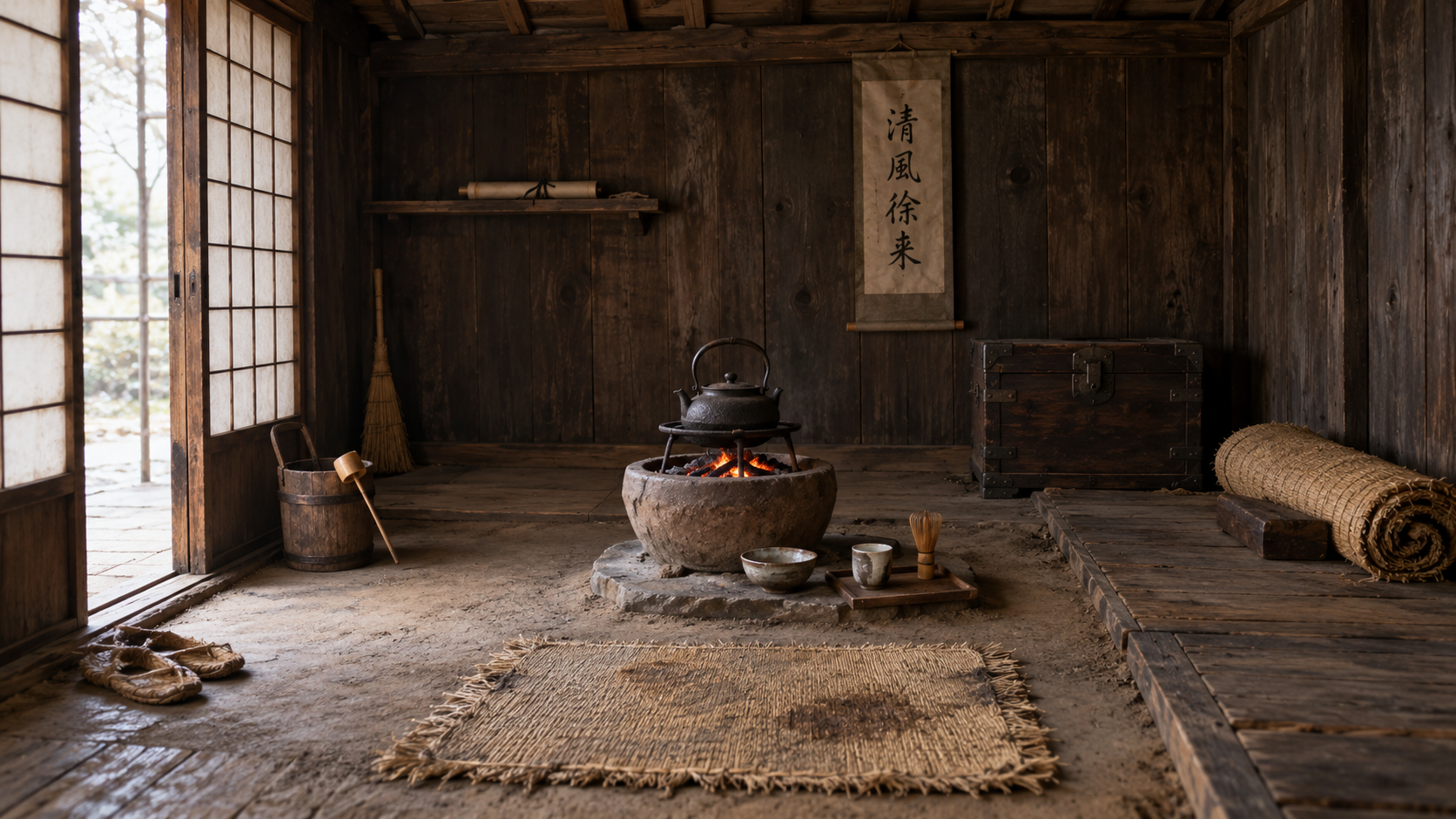

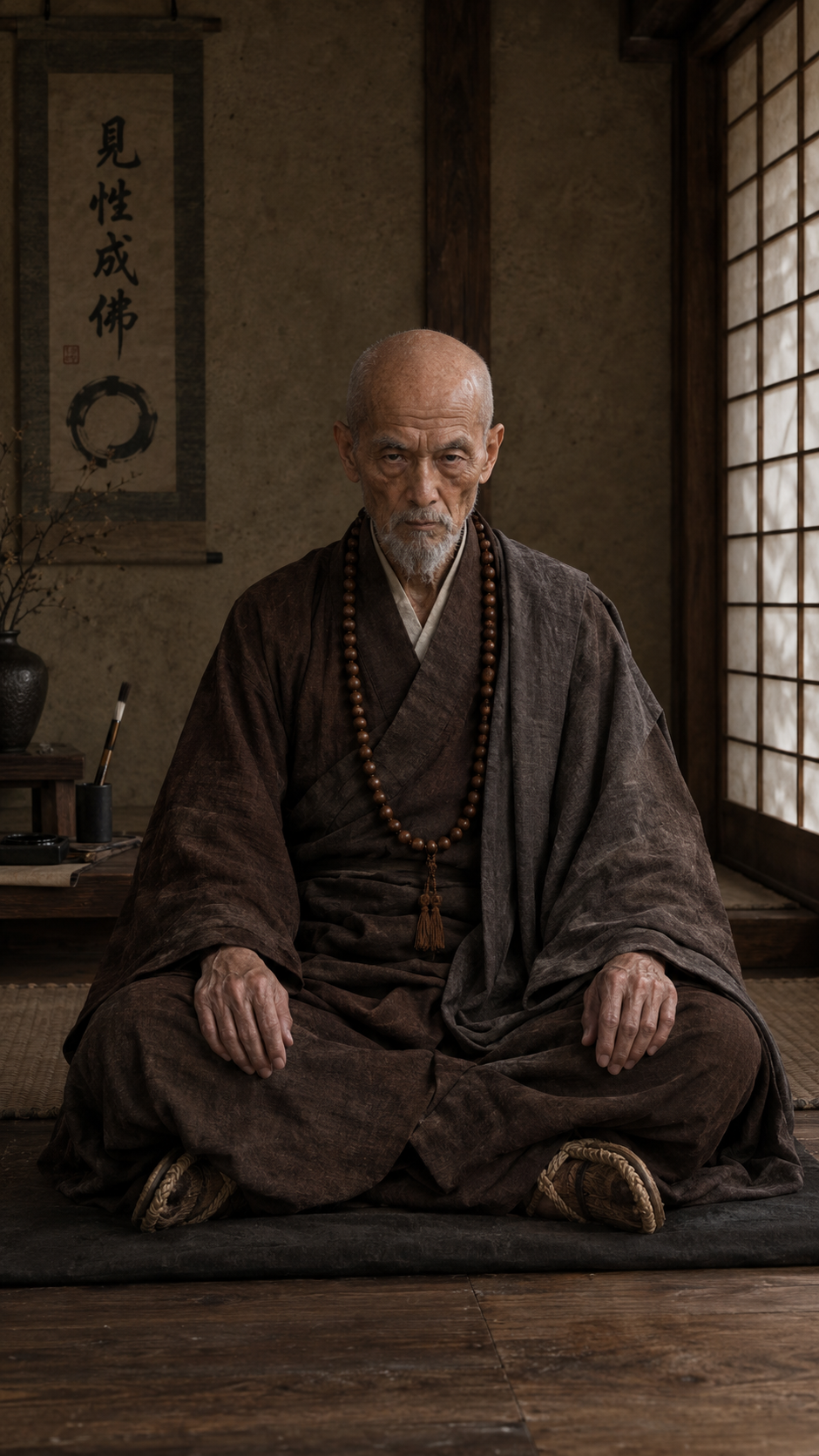








Interior of a traditional Japanese hermit monk's hut, Edo period Japan. Medium shot, eye-level. A tiny, nearly empty room. Walls of dark unworked wood, uneven planks, visible signs of age and handcraft. Floor — packed earth, partially covered with old rough wooden boards. Low wooden ceiling with exposed beams. Sliding shoji doors with paper panels and wooden lattice — one slightly ajar, soft daylight filtering through. In the center of the room — a clay hibachi brazier with glowing embers. The brazier stands directly on a flat stone set into the earth floor. On the brazier — an iron gotoku tripod stand, on it a small cast-iron teapot. Beside it on the stone — a simple clay bowl and a small ceramic cup. A tiny bamboo tea whisk on a wooden tray next to the cup. In the corner — a thin straw mattress rolled up, beside it a wooden pillow. Against the wall — a simple old wooden chest with iron fittings and a locked latch. On the floor in front of the brazier — a single small, old, heavily worn straw mat, frayed at the edges, stained with time. Only for sitting. On a wooden shelf by the wall — one rolled sutra scroll, lying horizontally. On the wall — one calligraphy scroll in ink, hanging from a wooden rod. By the entrance — a wooden bucket, a bamboo ladle, a pair of straw sandals. A small straw broom stands in the corner by the door. No books, no ornaments, no luxury, no modern objects, no electricity. Emptiness and simplicity. Extreme austerity, minimalism. Wabi-sabi aesthetic — beauty in poverty and imperfection. Daytime, neutral soft lighting: diffused daylight through shoji, warm glow from embers in the brazier. No harsh shadows, no direct sunlight. Muted natural palette — dark wood, earth, straw, grey stone, warm orange from embers. Photorealistic, cinematic, 35mm film, shallow depth of field. Edo period historical accuracy.
Free to start · Generate videos and images with AI in seconds