Image - 2026-08-25 04:40
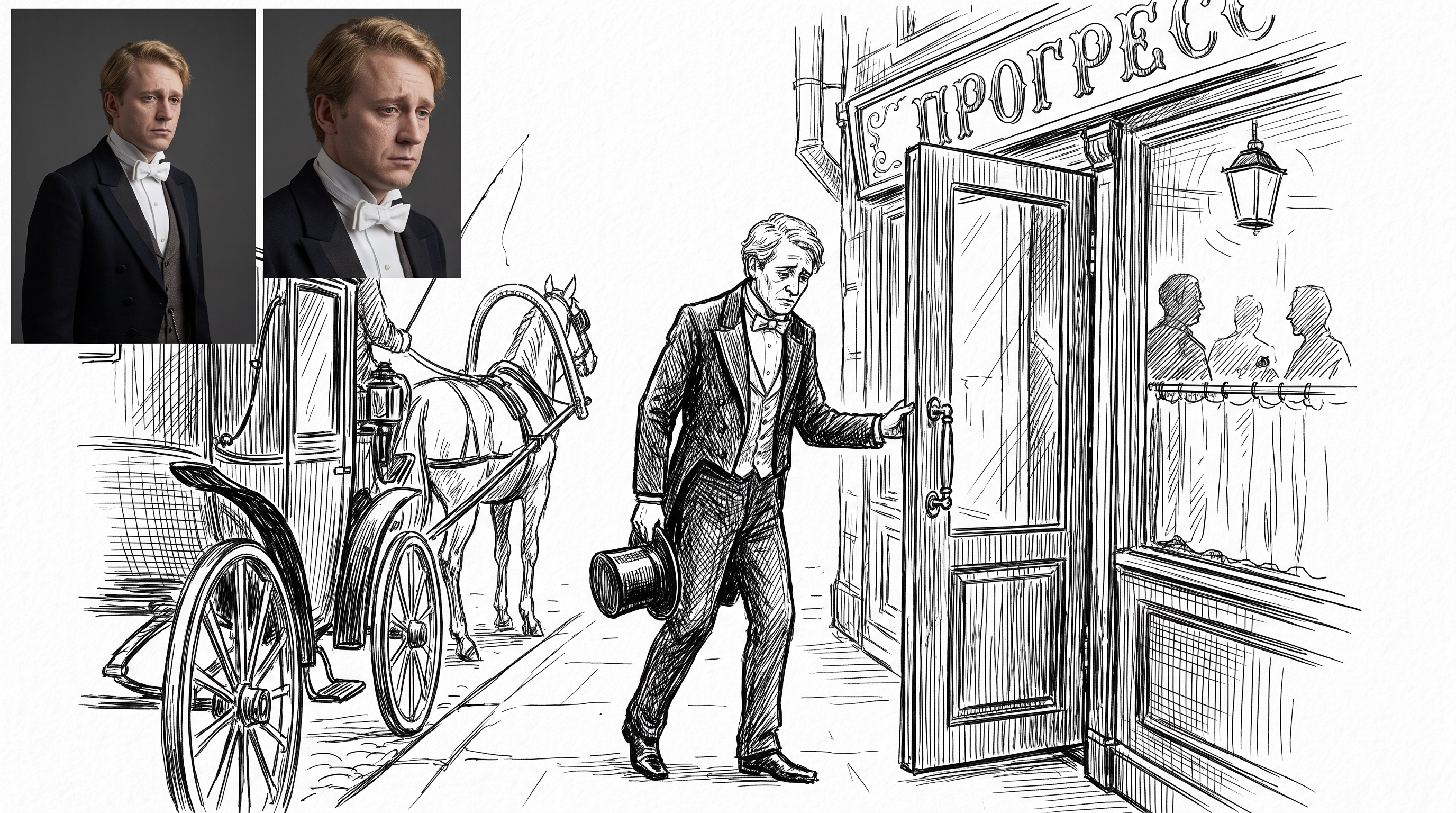
Transform this image into a pen-and-ink drawing in the style of Pushkin's manuscript illustrations, while strictly preserving the exact facial features, expression, and costume from the attached reference photo of Andreev. CRITICAL — CHARACTER ACCURACY (MAXIMUM PRIORITY): Andreev: Must remain EXACTLY as in the reference photo — his specific face, eyes, nose, mouth, cheekbones, blond hair, and expression. His face must be immediately recognizable. Do not alter, idealize, or generalize his features — only change the rendering technique to ink lines. Costume: Must be EXACTLY as in the reference — he wears a formal black tailcoat, black formal trousers, white shirt, white cravat (tie). He holds a black top hat (cylinder) in his hand. Expression: His face shows deep disappointment, resignation, and the heavy decision to drown his sorrows. He is not angry — he is hollow, defeated, and moving forward because he has nowhere else to go. Action: He steps out of the carriage, walks to the restaurant door, opens it, and enters. The movement is slow, deliberate, heavy with defeat. DO NOT change, idealize, or generalize his face. Keep every unique, specific feature from the reference photo. Preserve his hairstyle and hair color exactly as in the reference photo (blond). Scene: Outside the restaurant "ПРОГРЕСС" (Progress) in Saint Petersburg, late 19th century, summer evening. Andreev steps out of the horse-drawn carriage, walks across the steps, opens the restaurant door, and enters. He is in full formal attire — black tailcoat, black formal trousers, white shirt, white cravat, exactly as in the reference. He holds his black top hat (cylinder) in his hand. His body language is heavy with defeat — his shoulders are slumped, his steps are slow but determined. He moves as if carrying a great weight. The restaurant "ПРОГРЕСС" — an elegant building with large windows, a glowing entrance with lanterns, and a sign above the door reading "ПРОГРЕСС" in ornate 19th-century Cyrillic letters. Several stone steps lead up to the entrance. He walks toward the door, reaches out with his free hand, and pushes it open. His carriage is behind him — the driver watches him go, the horse stands patiently. Through the restaurant windows, silhouettes of patrons are visible — people dining, laughing, a pianist playing. Warm light spills onto the steps. His top hat is in his hand, held loosely — a symbol of his fallen dignity. He does not look back — he has accepted his defeat and moves forward into the warm, inviting light. The mood is heavy with resignation — a man who has given up on his dreams and now seeks only to forget. Atmosphere: The mood is somber, heavy, and melancholic — a man at his lowest point The contrast between his defeat and the warm, inviting restaurant is palpable He is seeking escape in alcohol A sense of finality and resignation Style: Pure black ink on clean white paper — no colors, no sepia, no grey tones. Pushkin's characteristic style: light, flowing pen strokes, delicate linework, generous white space, slightly sketchy and unfinished quality. The character's face must be drawn with the highest precision — every line should serve to preserve his identity. Hand-drawn quality with visible searching lines and slight imperfections. Atmospheric and cinematic — the scene captures a moment of heavy defeat. Technical: Monochrome, black ink on white paper, Pushkin illustration style, character strictly based on reference photo, maximum facial accuracy, exact formal costume (black tailcoat, black trousers, white shirt, white cravat), blond hair, holding black top hat, stepping out of carriage, opening restaurant door "ПРОГРЕСС", entering, sign in Cyrillic, --ar 2.39:1
Free to start · Generate videos and images with AI in seconds
More from this creator


More Kie.ai images
См. все →