Image - 2026-08-11 11:37
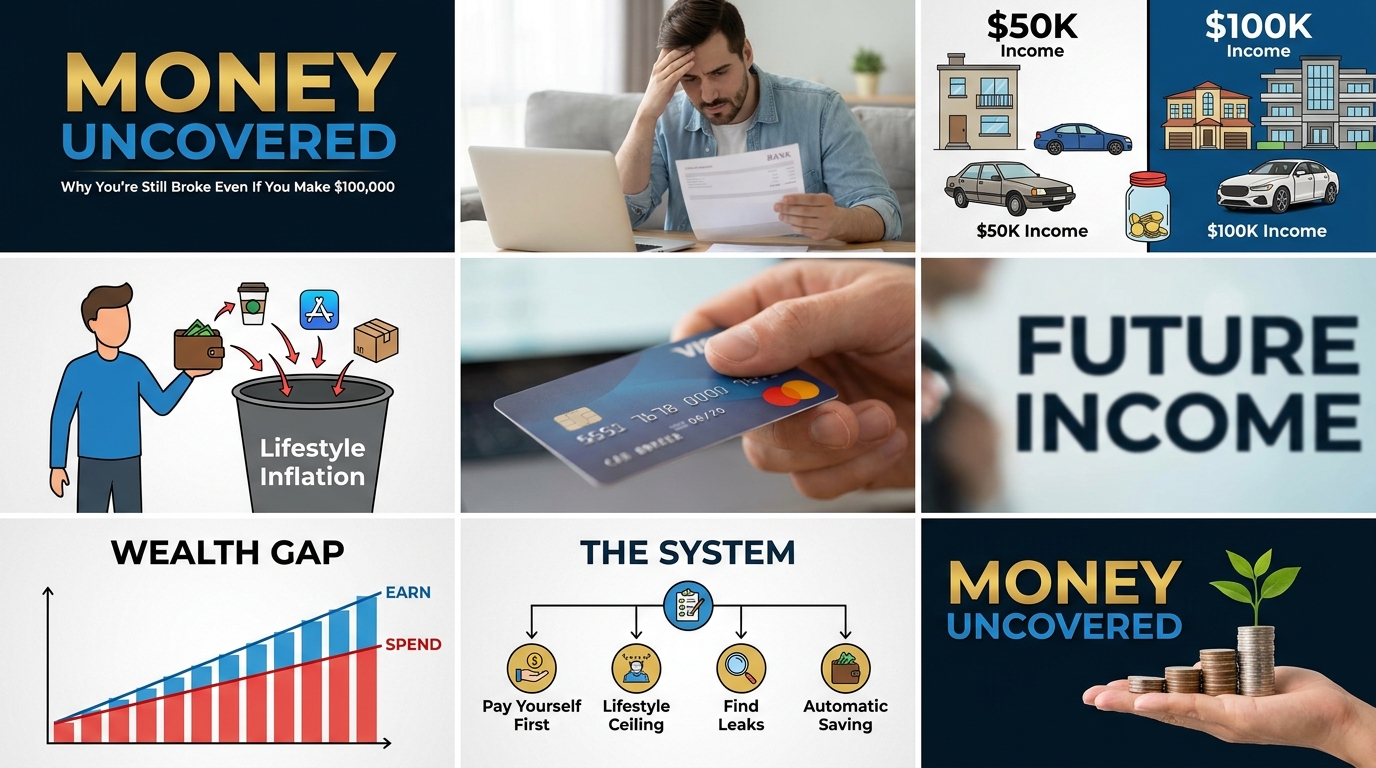
MONEY UNCOVERED Why You’re Still Broke Even If You Make $100,000 [OPENING — 0:00–0:45] Imagine this. You make one hundred thousand dollars a year. You have a good job. You live in a decent apartment. You drive a nice car. You eat at restaurants. You take vacations. From the outside, it looks like you’ve made it. But then payday comes. Your salary hits your bank account… And somehow, a few weeks later, you’re checking your balance and thinking: “Where did all my money go?” This is one of the strangest problems in modern money. You can make more money than most people… And still feel completely broke. So today, we’re uncovering why. And more importantly… How to break the cycle. ⸻ [CHAPTER 1 — THE $100,000 TRAP — 0:45–2:00] Meet Alex. Alex earns $100,000 a year. That’s roughly $8,300 a month before taxes. Alex thinks: “If I could just make more money, everything would be easier.” Then Alex gets a raise. And something strange happens. Instead of becoming richer… Alex becomes more expensive. The apartment gets upgraded. The old car gets replaced with a newer one. The restaurant that used to be a special occasion becomes a weekly habit. Then come the subscriptions. Streaming. Food delivery. Gym memberships. Apps. Online shopping. And little purchases that don’t feel important individually. Five dollars here. Twenty dollars there. Fifty dollars somewhere else. None of them feel dangerous. Until you add them together. And suddenly… The raise is gone. This is called lifestyle inflation. And it is one of the biggest reasons high earners can stay financially stuck. ⸻ [CHAPTER 2 — THE MORE YOU MAKE, THE MORE YOU CAN SPEND — 2:00–3:15] Here’s the trap. When your income increases, your brain doesn’t automatically think: “Great. Now I can save more.” It often thinks: “Great. Now I can finally afford the things I wanted.” A better apartment. A better car. Better clothes. Better vacations. More convenience. More comfort. And because these purchases happen gradually… You don’t feel like you’ve changed your lifestyle. But you have. Imagine someone earning $50,000 a year. They spend $45,000. They have $5,000 left. Now imagine they double their income to $100,000. But their lifestyle also doubles. They spend $95,000. Now they have only $5,000 left again. Their income doubled. Their financial freedom didn’t. That’s the difference between making money and keeping money. ⸻ [CHAPTER 3 — THE INVISIBLE MONEY LEAKS — 3:15–4:30] Most people know about the big expenses. Rent. Mortgage. Car payments. Insurance. But the biggest problem isn’t always one huge purchase. It’s the invisible leaks. You order food because you’re tired. You buy something online because it’s on sale. You upgrade your phone because the monthly payment doesn’t look expensive. You subscribe to another service because it’s only ten dollars. You use credit because you know you’ll get paid next week. None of these decisions feels like a financial disaster. But money doesn’t disappear all at once. It disappears quietly. One transaction at a time. And there’s another problem. Modern businesses are designed to make spending feel painless. One-click purchases. Saved cards. Monthly subscriptions. Buy now, pay later. Automatic renewals. Everything is designed to remove the moment when your brain says: “Wait. Do I actually want to spend this money?” ⸻ [CHAPTER 4 — THE CREDIT CARD ILLUSION — 4:30–5:30] Credit cards can make this even worse. When you pay with cash, you physically see the money leave. When you use a card… It can feel almost invisible. You buy dinner. Swipe. You buy clothes. Swipe. You book a vacation. Swipe. And the bill arrives later. The danger isn’t the credit card itself. The danger is using future income to pay for today’s lifestyle. Because eventually… Tomorrow’s money becomes responsible for yesterday’s decisions. And when that happens repeatedly… You aren’t building wealth. You’re simply moving money through time. ⸻ [CHAPTER 5 — WHAT WEALTHY PEOPLE ACTUALLY DO DIFFERENTLY — 5:30–6:45] Here’s the part nobody tells you. Building wealth isn’t primarily about looking rich. It’s about creating a gap between what you earn… And what you spend. That gap is where your future lives. If you earn $100,000 and spend $99,000… You aren’t financially free. If you earn $60,000 and consistently spend $45,000… You are building something. The goal isn’t to never enjoy your money. The goal is to make sure every dollar has a job. Some dollars pay for your life today. Some dollars protect you from emergencies. And some dollars buy your future. That’s the money most people forget. ⸻ [CHAPTER 6 — THE SYSTEM — 6:45–8:15] So how do you actually fix this? Not with motivation. With a system. Step one: Pay yourself first. The moment your income arrives, automatically move a percentage into savings or investments. Don’t wait to see what’s left at the end of the month. Because if you wait… There usually won’t be anything left. Step two: Create a lifestyle ceiling. When your income increases, don’t automatically increase your spending. Give yourself a raise… But keep part of the raise. If your income increases by $1,000 a month, you don’t need to spend the entire $1,000. Maybe you spend $300. And keep $700. That’s how raises turn into wealth. Step three: Find your three biggest leaks. Don’t obsess over every coffee. Look at the big categories. Housing. Transportation. Debt. Food. Shopping. Subscriptions. Fixing one large expense can matter more than eliminating twenty tiny ones. And step four: Make saving automatic. Your financial system should work even when you’re tired. Even when you’re busy. Even when you’re emotional. Because relying on willpower is a terrible financial strategy. ⸻ [ENDING — 8:15–9:00] So… Why are you still broke even if you make good money? Maybe you’re not actually earning too little. Maybe your lifestyle simply grew faster than your wealth. Because the uncomfortable truth is this: A bigger paycheck doesn’t automatically create financial freedom. If your spending rises every time your income rises… You’ll always feel like you’re behind. But once you learn to keep the gap… Everything changes. Your money stops disappearing. Your savings start growing. Your investments start working. And eventually… You stop asking: “How much more do I need to earn?” And start asking: “How much of what I earn can I keep?” This is Money Uncovered. We don’t just talk about making money. We uncover where it goes. And why. Subscribe to Money Uncovered. Because your paycheck isn’t the whole story. It’s what you do with it that changes everything.
Free to start · Generate videos and images with AI in seconds
More from this creator


More L images
См. все →